for three recorder headjoint players (2025)
Commission
Bux Ensemble
Instrumentation
- Recorder Headjoints I – Sopranino, Soprano and Alto
- Recorder Headjoints II – Alto
- Recorder Headjoints III – Bass, Tenor and Alto
Duration
8’30”
Premiere
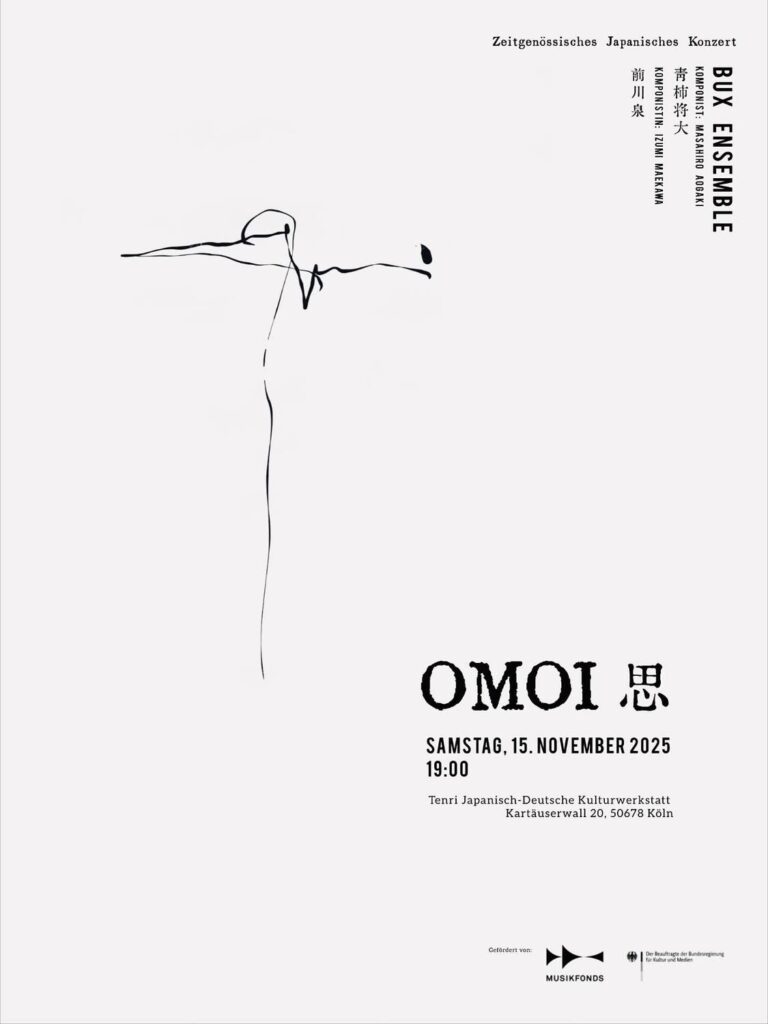
15th November 2025, Cologne (Germany), Tenri Japanisch-Deutsche KulturWerkstatt e.V.
Bux Ensemble: Wei Hung, Chia-Ying Chuang and Franziska Salker
Programme Note (EN)
Hiyomeki, in Japanese, is a colloquial term for the anterior fontanelle — the unossified part of an infant’s skull at the intersection of the frontal and parietal bones — which quivers faintly with the pulse. This area normally closes between twelve and eighteen months and embodies extreme fragility, with the bones not yet joined, symbolising a formative stage in which the boundaries between inside and outside, self and other, remain undetermined.
In this work, three spatialised performers play seven recorder headjoints. The piece consists of two seamlessly connected sections. In the first, six patterns of three-note neuma, shaped through the performers’ mutual callings, are presented calmly, always with subtle tremors. In the second section, within a freer temporality, the performers abandon the neuma and gradually draw closer to one another sonically. The piece evokes an infant’s first wordless encounter with the world — a privileged moment of listening from which one can never return — when sound has not yet acquired meaning but simply touches the body as vibration. It explores the primordial threshold between sound and body, meaning and non-meaning, and contact and non-contact.
The concept derives from the premier concert’s theme, “思”: its upper component, “田” — written as “囟” in Tenshotai, the ancient seal script — was originally a pictograph representing the hiyomeki.
委嘱
ブックス・アンサンブル
楽器編成
- リコーダー頭部管I – ソプラニーノ、ソプラノ、アルト
- リコーダー頭部管II – アルト
- リコーダー頭部管III – バス、テノール、アルト
演奏所要時間
8分30秒
初演
2025年11月15日、天理日独文化工房(ドイツ・ケルン)
Bux Ensemble: Wei Hung, Chia-Ying Chuang and Franziska Salker
プログラム・ノート
「ひよめき」とは、乳児の頭蓋骨にある未縫合部・大泉門の俗称で、前頭骨と頭頂骨の交わる部分に位置し、脈の鼓動に合わせてかすかに震える。この部分は通常、生後12〜18か月の間に閉じるが、骨がまだ結合していないという極度の脆さを抱えており、内と外、自己と他者の境界がまだ定まらない、生の形成期を象徴している。
本作では、空間的に配置された三人の奏者が、計七本のリコーダーの頭部管を用いて演奏する。曲はシームレスに連続する二つのセクションから構成されている。前半では、三人の呼び交わしによって形づくられる三音のネウマの六つのパターンが、微細な震えを常に伴いながら淡々と提示される。後半では、より自由な時間感覚の中でネウマを手放し、三人は音響的に徐々に互いへと近づいていく。
言葉を持たない乳児が他者の声に耳を澄まし、世界に初めて出会う——二度と戻ることのできないその「聴くこと」の特権的な時間において、音はまだ意味を持たず、ただ震えとして身体に触れる。本作は、音と身体、意味と非意味、接触と非接触のあわいにある、原初的な感覚の閾を探る試みである。
なお、初演時の公演テーマである「思」という漢字の上部「田」が、篆書体では「囟」と書かれ、もともとこの「ひよめき」を象った象形文字であったことから本作の着想を得たことを付記しておく。